Connecting and integrating with new global value chains
Traditional metal processing faces challenges with high precision and complex geometry processes, making transformation difficult. Industry 4.0 smart factories combine IoT and big data analytics to achieve modularization and full-line flexible manufacturing, improving production efficiency and visibility.
Challenges in the Metal Processing Industry
- 01
Numerous components in metal processing make supply chain status difficult to track
The metal processing chain is very complex, with many product specifications and processes. Over 90% of manufacturers are small and medium-sized enterprises. Each manufacturer positions itself in niche markets and focuses on their respective production capabilities. Division of labor in metal processing usually involves cooperative alliances and mutual technical support between industries. Operators specify materials and specifications according to their needs. Manufacturing suppliers take orders for customization or order production, but progress tracking is both complex and difficult.
- 02
Complex after-sales service
Customers immediately demand service when problems occur, shortening equipment downtime. More and more metal processing manufacturers are beginning to utilize information technology to enhance their competitive advantage in after-sales service processes. Machine tools are equipment with high unit prices, high technicality, many components, and complex assembly processes. Therefore, the metal processing industry must have stable quality and quickly provide parts replacement services in maintenance services to avoid losses caused by production shutdowns.
- 03
Demand challenges for high-value, high-end applications
The aerospace, automotive, and other high-value industries are highly complex and intensive industries. Each industry must establish collaborative business environments. Databases with the same format and standards can support product development and, combined with after-sales service information, break through past uncertainties. In this way, the metal processing industry can accelerate the speed from concept formation to prototype production, modification, and testing completion, shortening development time and improving product quality to enter mid-to-high-end markets.
- 04
Labor shortage caused by declining birth rates and aging population
Traditional metal processing industries often face problems in manufacturing processes such as dust, debris scattering, heavy lifting, cuts, bruises, and other occupational hazards. This also makes people generally perceive the metal processing industry environment as harsh and is often viewed as a labor-intensive industry. Therefore, employment willingness is greatly reduced, and coupled with social trends of declining birth rates and aging population, labor shortages result, causing great challenges for the metal processing industry.
Metal Processing Industry iFactory
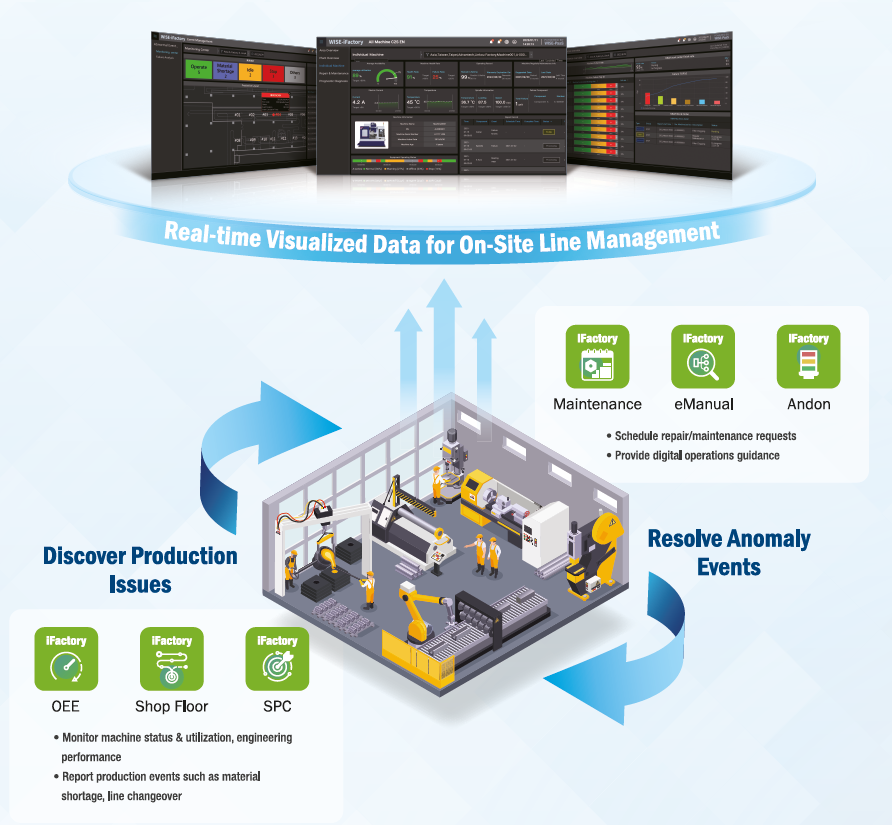
The iFactory metal processing solution suite focuses not on improving capacity utilization but on improving production yield. By implementing a series of functions including data processing, storage, communication protocol conversion, and transmission, it will drive intelligent transformation in the metal processing industry.
Advantages
- 01
Real-time production and quality monitoring
- 02
Upgraded after-sales service management
- 03
Improved metal processing technology
- 04
Enhanced value chain integration
- 05
Production flexibility
- 06
IoT connectivity and flexible production scheduling
Solution Suite I.Apps

Preventive Maintenance
The preventive maintenance system allows you to regularly maintain equipment and assets and keep them running, preventing downtime due to unexpected equipment failures.

Overall Equipment Effectiveness (OEE)
Visual monitoring of OEE indicators and KPIs across the entire factory through data acquisition, integration, and machine utilization analysis. Easily achieve smart factory production efficiency management, improve productivity, review and analyze major losses, enhance equipment utilization, and effectively increase production capacity.

Andon
The Andon application is an alarm system that can trigger signals when problems occur during the manufacturing process, improving response time for supervisors or technicians.

Shop Floor
A manufacturing management system for real-time production tracking, scheduling, and work order or operation status reporting, effectively improving supervisor progress control.
System Architecture for Metal Processing Industry
DFSI Co-creation Partners
Industrial IoT (IIoT) involves integrating big data, cloud, and AI applications. To align with this trend, Advantech collaborates with domain-focused system integrators (DFSI) to develop industrial applications (I.Apps).