Digital Transformation in the Footwear Industry
Unlike high-tech industries with abundant professional IT talent, traditional industries such as footwear and textiles must pay more attention to product usability during the transformation process. The footwear and textile industries are traditional industries. Usually, major customers will propose change requests, ideas, practices, or new manufacturing methods. Although many have achieved production automation, data collection still relies on manual input or copying, and data collection times are not synchronized. The quality and quantity of this data are insufficient for big data analysis and production process improvement. Introducing smart manufacturing systems is not achieved overnight but must be done gradually. Footwear manufacturers should first analyze smart manufacturing needs within their factories, establish IoT platforms to build infrastructure for operational data and equipment status monitoring, and then introduce vertical application domains.
Challenges in Footwear Industry Management
- 01
Lack of Human Resource Advantages
- Large technical gaps among professional talent
- Most processes heavily rely on manual labor
- Equipment types are diverse and complex, making professional talent training difficult
- 02
Difficulties in Lean Production Transformation
- Small batch, high variety production nature
- Production planning and scheduling are difficult to integrate
- 03
High NG Rate in Foaming Processes
- Difficult temperature and humidity control
- Difficult to control chemical changes
- Quality management is difficult, most equipment still relies on manual operation
- 04
High Technical Control Standards
- Processing quality and efficiency highly depend on experienced shoemakers
- Gap in experience transfer from senior mold talent
- Faster design, shorter delivery times, higher costs, and lower profits bring numerous difficulties to the mold industry
- 05
Machine Management Obstacles
- High failure rates, difficult to detect and predict
- Insufficient transparency and systematization of equipment information
- Difficult cross-equipment information streaming
Footwear Industry iFactory
The Footwear Industry iFactory solution suite provides customers with easy-to-use tools to enhance sustainability and profitability throughout the entire engineering and operational processes, while maximizing asset, production, and supply chain performance.
Advantages
- 01
Growth-Oriented
Completing factory transformation in one step is not easy, and most manufacturers are stalled by high costs and time-consuming issues. Therefore, we provide comprehensive edge-to-cloud solutions that bring long-term solutions to users, gradually transforming factories without paying high costs and wasting time.
- 02
Flexibility and Agility
We divide various functions into different I.Apps, providing multiple application choices through small-scale implementation. This simplifies factory transformation and quickly presents results.
- 03
Technology-Driven
We co-create with many partners, generating different I.Apps in their respective specialized fields, making I.Apps more dedicated and professional, and of course, closer to customer needs.
- 04
Innovation
To meet different needs, we can also combine I.Apps from different fields into customized applications to satisfy various requirements.
Solution Suite I.Apps

OVEN - Temperature Management
Oven temperature control is a key technology for quality control and affects the tightness between the shoe upper and sole. It not only determines the final product outcome but also affects the final comfort of the product. To improve overall efficiency and output quality, accurate and effective data collection and reliable information analysis have become increasingly important in the shoemaking process. The OVEN I.App provides accurate oven temperature information, offering more effective information for on-site supervisors and managers for faster and more effective decision-making, and providing more transparent reference information during audits.

Mold Temperature Monitoring
Inner-Mold Temperature Monitoring: Inner-mold temperature is one of the most difficult challenges in the foaming process. Even slight temperature differences can significantly affect output quality and defect rates. In traditional methods, manufacturers usually estimate inner-mold temperature by measuring mold surface temperature, which leads to consistently high defect rates in foaming processes. The Inner-Mold I.App provides accurate inner-mold temperature and related process information, attempting to solve quality issues that are always difficult to control in the foaming process.

Formula and Chemical Process Management
Variables in chemical processes are key factors affecting the entire production process, making quality control and production results difficult to control, and making it difficult to pass on the experience of professional shoemakers. The Chemical I.APP provides transparent and systematic production equipment information to record, track, and analyze all formulas and variables in each work order. It also provides real-time production process monitoring for on-site managers as a reference for rapid response and subsequent systematic experience transfer.

Shop Floor
Shop Floor is mainly used for work order and production process management to track, schedule, and report manufacturing work progress. It tracks work progress and milestone stages, providing supervisors with more comprehensive production data for production efficiency judgment, factory resource planning, and inventory assessment. It can also improve efficiency, sustainability, and identify production issues.
Footwear Industry Management System Architecture
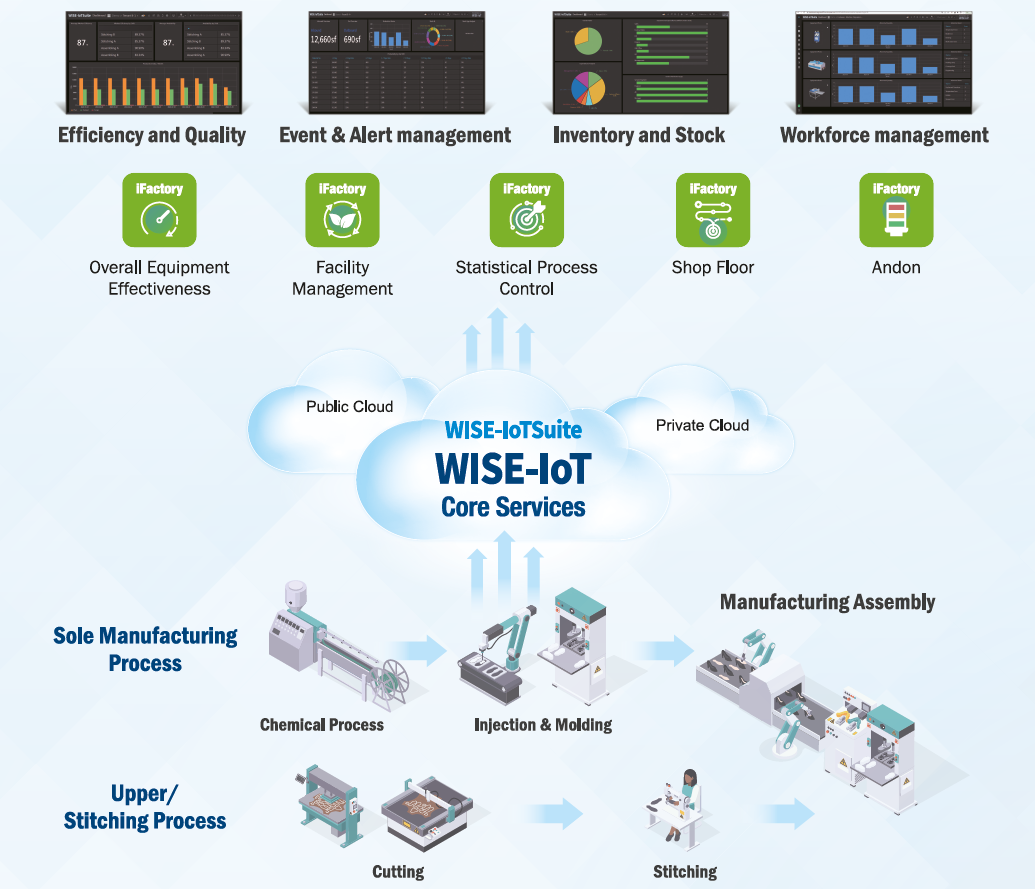
DFSI Co-creation Partners
Industrial IoT (IIoT) involves integrating big data, cloud, and AI applications. To align with this trend, Advantech collaborates with domain-focused system integrators (DFSI) to develop industrial applications (I.Apps).